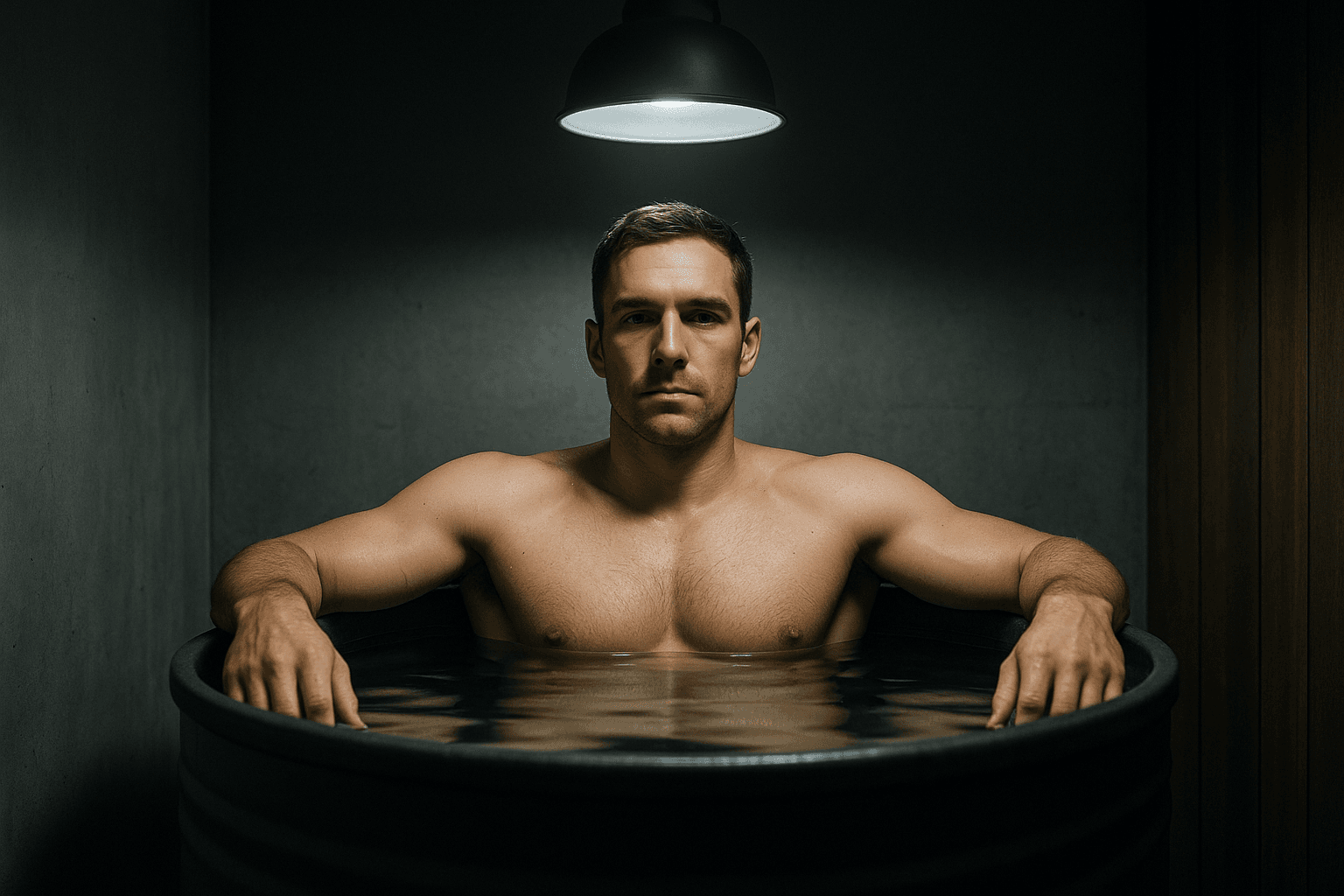
Let me tell you something most people get wrong about cold plunges.
They think it is a toughness exercise. Grit it out. Prove something to yourself. Post it on Instagram. But Brett, Tyler, and I did not build Debrief Recovery around cold plunges because we wanted people to suffer for clout. We built it around them because the science is genuinely remarkable — and because we have felt the difference ourselves.
Deliberate cold exposure triggers a specific neurochemical chain reaction in your body. One that, with consistent practice, measurably changes how your nervous system handles stress. Not as a metaphor. As documented, peer-reviewed physiology. The chemical at the center of that shift is norepinephrine. And if you are a business owner or professional running hard every day on the South Shore, understanding what it does — and why water temperature matters more than you think — is worth five minutes of your attention.
What Is Norepinephrine and Why Should You Care?
Norepinephrine is both a hormone and a neurotransmitter. Your adrenal glands release it. Neurons throughout your brain release it. You have probably heard it described as part of the "fight or flight" response — and that is accurate, but it is only half the picture.
In short, well-timed bursts, norepinephrine is exactly what you want. It sharpens attention, raises your heart rate, and mobilizes energy fast. It is your body's way of saying: something important is happening right now — be sharp. That is adaptive. That is useful. A well-placed norepinephrine spike before a high-stakes negotiation or a difficult conversation is not your enemy.
The problem most adults are actually dealing with is chronic, low-grade stress that keeps norepinephrine — and cortisol — elevated in the background, not in productive bursts but as a constant background hum. Over time, that persistent activation degrades your ability to fully recover. You feel edgy without knowing why. Small stressors start hitting like big ones. Your baseline reactivity creeps up.
The goal is not to eliminate norepinephrine. It is to train your nervous system to handle its release — and return to calm — efficiently. That is where cold exposure enters the conversation.
The Research: Cold Water, Norepinephrine, and Your Nervous System
Here is where this gets genuinely interesting. Cold exposure does not just feel intense. It produces a measurable, documented physiological response that you can actually train over time.
A 2000 study by Srámek et al., published in the European Journal of Applied Physiology, measured norepinephrine levels in subjects exposed to cold water immersion. The researchers found substantial increases above resting baseline — with the magnitude of the response scaling with colder water temperatures and longer duration of immersion. Colder water, longer hold, stronger response. That is the variable that separates meaningful cold exposure from a brisk shower.
The other landmark reference point is the Kox et al. study published in PNAS in 2014, which examined trained subjects using cold exposure protocols. Trained participants could produce a controlled spike in epinephrine and norepinephrine — and then return to baseline faster than an untrained control group. The stress response was activated deliberately, then resolved. That resolution — that return to calm — is the whole game.
Dr. Andrew Huberman, a neuroscientist at Stanford University, has discussed this research extensively through his public scientific communication and has cited peer-reviewed cold immersion data showing that deliberate cold exposure in a genuinely uncomfortable temperature range is one of the most reliable and reproducible ways to elevate norepinephrine in a controlled setting.
What the science points to, consistently, is this: the spike itself is not the adaptation. The practice of moving through the spike and recovering from it is. You are doing controlled stress reps for your nervous system. Like interval training builds cardiovascular capacity, consistent cold exposure builds your capacity to handle stress without getting stuck in it.
Why the Morozko Forge Is Not Just a Cold Plunge
![Morozko Forge cold plunge at Debrief Recovery, Norwood MA]
Not all cold plunges create equal stimulus. This distinction is not marketing — it is physics and physiology.
A cold shower hovers in the 60–65°F range on a good day. A poorly maintained plunge tank drifting above 55°F produces mild discomfort. Neither consistently produces the norepinephrine response that the published research measures. Temperature and duration are the two variables that determine whether you are triggering meaningful physiological adaptation — or just being briefly cold.
The Morozko Forge runs at 38–45°F with active chilling and filtration that maintains that temperature precisely. The water does not warm up after the first 90 seconds the way an ice bath or an underpowered tank does. It stays cold. That stability is essential because your nervous system needs a reliable, consistent stimulus to adapt to. Variable cold does not build the same adaptation.
At Debrief, we pair the Morozko Forge with our traditional 195°F saunas as part of a structured contrast therapy protocol. That is not a random combination. Research published in the Scandinavian Journal of Medicine and Science in Sports supports contrast therapy — alternating heat and cold — for both physical recovery and autonomic nervous system regulation. The dramatic temperature shift between 195°F and 40°F creates a stronger overall physiological response than either modality alone.
Brett, Tyler, and I guide every first-time member through the protocol. Duration matters. Three minutes at 40°F is not the same as 30 seconds. We help you build to effective immersion time safely, based on where you are starting from.
What This Actually Looks Like in Real Life
One of our members — a business owner who started coming in twice a week — told us something specific after about six weeks. He said he noticed he had stopped white-knuckling difficult conversations. There was, in his words, "more space between the stressor and the reaction." He was not less aware of pressure. He was less hijacked by it.
That is exactly what the research predicts. When you repeatedly move through a controlled norepinephrine spike and return to calm, your nervous system gets better at that cycle. The recovery window shortens. Baseline reactivity decreases. You become harder to rattle in the moments that matter most.
This is not anxiety treatment — we are not making that claim, and you should be skeptical of anyone who does. What we are saying is that deliberate cold exposure, done consistently with proper temperature and duration, trains your stress response the same way interval training conditions your cardiovascular system. The adaptation is real. It is documented. And it shows up where it counts — in negotiations, in tough calls, in the moments your business and your people need you most. 💪
Come Experience It at Debrief Recovery
You can read about norepinephrine all day. The adaptation only happens when you get in the water.
At Debrief Recovery in Norwood, MA, we run the Morozko Forge at precise temperatures, our traditional 195°F saunas stay at the temperatures the research supports, and our environment is genuinely unplugged — no phones, no screens, no noise. Brett, Tyler, and I built this place because we needed it ourselves. We use it every week. We know what it does.
Come see for yourself. Your first session is free. No sales pitch. Just show up, get guided through the protocol, and feel the difference.
We are at the Rojo Office Park in Norwood, behind the Valvoline. Free parking out front.
👉 Book your free intro session at debriefrecovery.com
Frequently Asked Questions
How does norepinephrine affect the stress response?
Norepinephrine is a hormone and neurotransmitter your body releases during stress. In short, purposeful bursts, it sharpens focus and mobilizes energy — which is exactly what you want. The problem is chronic background stress that keeps norepinephrine elevated constantly, degrading recovery and increasing baseline reactivity. Training your nervous system to release and then efficiently resolve norepinephrine is the adaptation goal — and deliberate cold exposure is one of the most reproducible ways to practice that cycle, according to published research including Srámek et al. (2000) in the European Journal of Applied Physiology.
What makes the Morozko Forge different from a standard cold plunge?
The Morozko Forge maintains stable water temperatures in the 38–45°F range using active chilling and filtration. Unlike ice baths or underpowered tanks that warm up within minutes, the temperature holds. That stability matters because your nervous system needs a consistent, reliable stimulus to adapt to. At Debrief Recovery, we pair it with our traditional 195°F saunas as part of a structured contrast therapy protocol supported by published research.
How many sessions before I notice a difference?
It varies by person and consistency. Some members notice a shift in baseline calm within two to three weeks of twice-weekly sessions. The research on physiological adaptation generally points to four to six weeks of regular practice before nervous system changes stabilize. Consistency matters far more than any single session.
Why is cold exposure specifically useful for stress resilience?
Cold exposure forces your body into a controlled stress response — norepinephrine spikes, heart rate elevates, your system activates. The practice of moving through that response calmly, and watching your body return to baseline, trains your nervous system to handle stress more efficiently. The Kox et al. study (PNAS, 2014) showed trained subjects could produce this response and recover from it faster than untrained controls. The result is not less awareness of pressure — it is less reactivity to it.
Is this safe for someone new to cold plunging?
Yes — with proper guidance. Brett, Tyler, and Cody walk every first-time member through the full protocol: how to breathe through the initial shock response, how long to aim for, and how to use the 195°F sauna before and after. Your first session is free and fully guided. You will not be dropped in alone without context or support.