Most people have sat in a sauna at some point — a hotel, a gym locker room, maybe a recovery studio. It felt warm. Maybe relaxing. You walked out feeling loosened up and called it good.
But here is the honest truth: if that sauna was sitting around 140°F, you were leaving most of the benefit on the table.
We say that not to be contrarian, but because it matters — and because the science backs it up clearly. At Debrief Recovery, we run our traditional saunas at 195°F. That number is not a marketing decision. It is the temperature range where the actual published research on sauna therapy was conducted. Where the cardiovascular responses happen. Where the hormones shift. Where your body does what heat stress is supposed to make it do.
Think of it this way: a 140°F sauna is like jogging to the mailbox and calling it cardio. It counts for something. It is just not the thing.
This article gets into why temperature is the mechanism — not just a detail — and what traditional saunas actually do for your body when you do it right.
What "Traditional Sauna" Actually Means
Before we get into the science, let us be specific about terms — because this space is full of muddled language.
A traditional sauna heats the air around you using a wood-burning or electric stove with rocks on top. You can pour water on those rocks to create steam (löyly, in Finnish). The air temperature climbs. Your body responds to that hot air. That is the mechanism.
This is fundamentally different from an infrared sauna, which uses light panels to heat your body directly at much lower air temperatures — typically 120°F to 140°F. Different mechanism. Different physiological response. Different research base.
At Debrief Recovery, we run traditional saunas. No infrared. We made that choice deliberately, and the reason is simple: the research that established sauna therapy as a legitimate recovery and cardiovascular tool was done in traditional Finnish saunas running at high temperatures. If we want the benefits that research documented, we have to replicate the conditions that research used.
The Finnish Research — and Why Temperature Is the Mechanism
The most rigorous long-term sauna research in the world comes out of Finland, where sauna bathing is not a wellness trend. It is a cultural practice embedded in daily life for centuries. And because Finns have been doing it that long, researchers have had decades of population data to work with.
One landmark study — the KIHD (Kuopio Ischemic Heart Disease) study, published in JAMA Internal Medicine in 2015 — followed 2,315 Finnish men over 20 years and found that those who used the sauna four to seven times per week had a 63% lower risk of sudden cardiac death compared to those who used it once a week. Frequent sauna users also showed significantly reduced risk of fatal cardiovascular disease and all-cause mortality.
That study used traditional Finnish saunas running at approximately 174°F to 212°F. Not infrared rooms. Not warm lounges. High-heat traditional saunas.
Separately, research published in peer-reviewed journals has documented the acute physiological response to traditional sauna heat: heart rate climbs to between 100 and 150 beats per minute — comparable to moderate aerobic exercise. Skin and core temperature rise. Blood vessels dilate. Cardiac output increases. These are not subtle effects. They are the same kinds of stress responses your cardiovascular system adapts to through exercise.
Here is the point that tends to get overlooked: these responses are temperature-dependent. Research from Laukkanen and colleagues — some of the most-cited sauna scientists working today — has repeatedly noted that the magnitude of the cardiovascular and hormonal response correlates with the intensity of the heat exposure. A sauna running at 140°F simply does not produce the same physiological stress as one running at 195°F. The mechanism is blunted. The adaptation is smaller.
This is why we set our saunas at 195°F and do not apologize for it.
What Is Actually Happening to Your Body at 195°F
Let us walk through the physiology in plain terms — because once you understand what is happening, the recovery benefits stop feeling abstract.
Your Cardiovascular System Gets a Workout
When you sit in 195°F heat, your body's core temperature begins rising within minutes. To manage that, your heart rate increases and your blood vessels dilate — particularly near the skin surface, where heat can be released. This shunts blood away from your core and toward your periphery, increasing cardiac output significantly. The KIHD study authors compared the cardiovascular load of a sauna session to moderate-intensity physical exercise, and the analogy holds up.
Over time and repeated sessions, this cardiovascular stress produces adaptation — the same principle behind why exercise makes your heart stronger. Your vessels become more compliant. Your resting heart rate can drop. Your circulation improves.
Norepinephrine Rises Sharply
This is the piece that surprises people most — and it is worth citing specifically. A study by Leppäluoto et al. published in Acta Physiologica Scandinavica found that a single traditional sauna session at high temperatures produced substantial increases in plasma norepinephrine concentrations. Norepinephrine is a neurotransmitter and stress hormone tied to focus, alertness, mood regulation, and the body's ability to manage pain and inflammation.
This is why people walk out of our sauna feeling mentally clearer — not just physically relaxed. The neurochemistry changed. That clarity is not just in your head. Well — it is in your head, but it is also in the published research.
Muscle Recovery Accelerates
Increased blood flow means increased delivery of oxygen and nutrients to muscle tissue, and faster clearance of metabolic byproducts like lactic acid. For anyone training hard — athletes, weekend warriors, people who spend their workdays on their feet — the practical effect is real: less soreness, faster readiness for the next session.
This is also why contrast therapy — pairing the sauna with a cold plunge — has become the gold standard for serious athletic recovery. The heat drives circulation and opens things up. The cold creates a vasoconstriction response that pushes that circulation deeper. Hot, cold, repeat. The contrast is the point.
The Unplugged Part Matters More Than You Think
We could have built a recovery studio with screens on the walls, music pumping, and a smoothie bar in the corner. Plenty of places do that.
We did not, because that is not what recovery actually looks like.
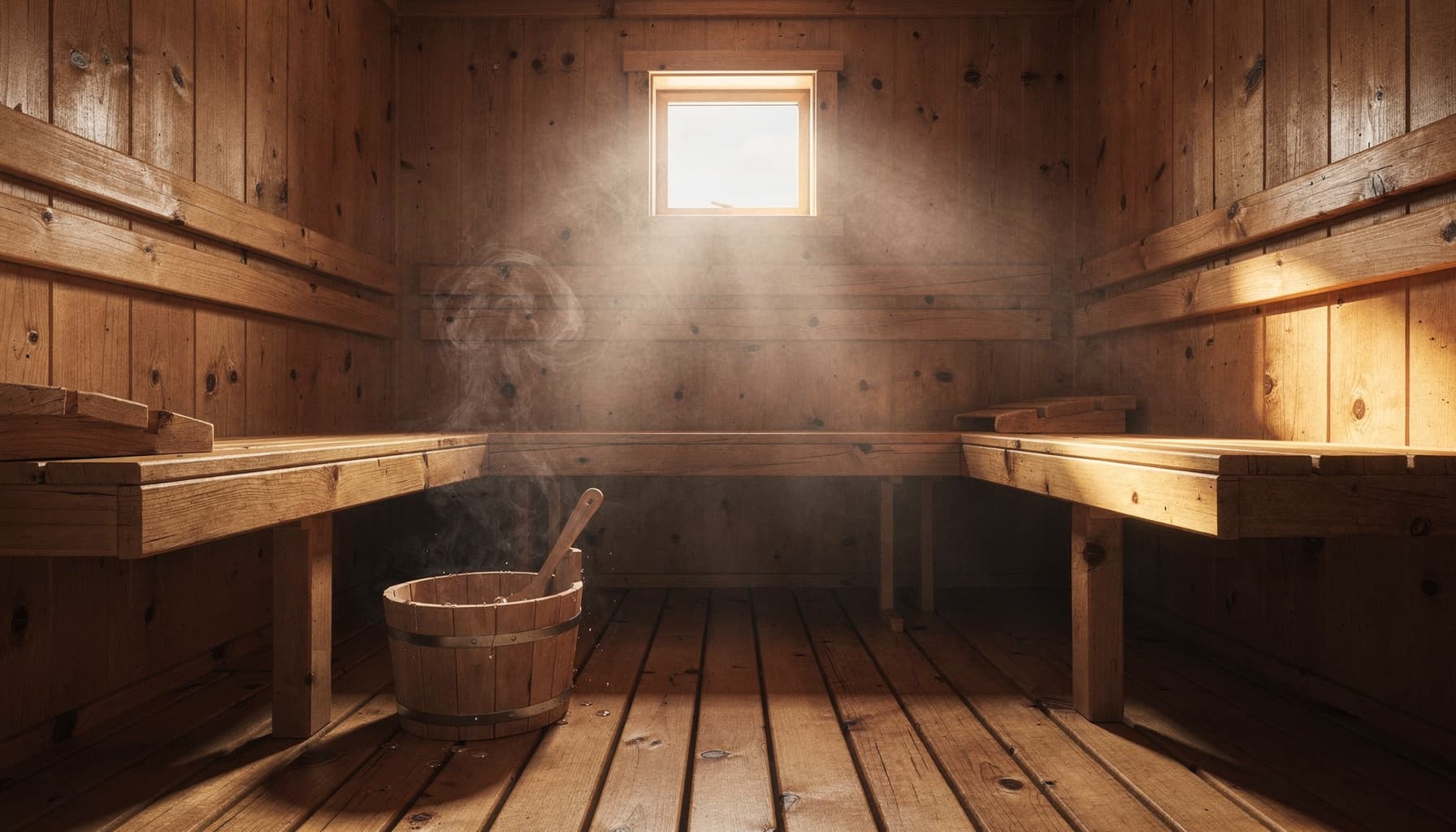
When you sit in a 195°F sauna at Debrief, there is no phone in your hand. No screen in front of you. No ambient noise. There is heat, steam, the wood bench under you, and whatever is going on in your own head. For most people — especially business owners and professionals who spend their days context-switching between seventeen different inputs — that silence is genuinely uncomfortable for about four minutes and then becomes the thing they come back for every week.
If you run a business, you already know the cost of never fully switching off. The sauna solves that problem in a way no app ever will, mostly because you cannot bring the app in with you.
The combination of high-heat physiological stress and genuine mental stillness is not something you can replicate anywhere else on the South Shore. We know because we looked before we built this place.
How to Get Started
You do not need a protocol, a recovery plan, or any prior experience. You need an hour and a willingness to sit in heat without your phone.
Your first session at Debrief Recovery is free. We will walk you through the session — how long to stay in, how to pair the sauna with a cold plunge on our Morozko Forge units, and what to expect from your first experience with real 195°F heat.
Book your free intro session at debriefrecovery.com
Rojo Office Park, Norwood, MA — behind the Valvoline on Route 1. Free parking out front.
Frequently Asked Questions
What are the benefits of a traditional sauna?
Traditional saunas — run at high temperatures like 195°F — drive real physiological responses: elevated heart rate, improved circulation, hormonal shifts including norepinephrine increases, and accelerated muscle recovery. Long-term research, including the KIHD study published in JAMA Internal Medicine, has associated frequent traditional sauna use with significantly reduced cardiovascular risk. The benefits are temperature-dependent, which is why running the sauna at 195°F matters.
How hot is a traditional sauna?
Traditional Finnish saunas typically run between 175°F and 212°F. At Debrief Recovery, ours are set to 195°F — squarely in the range used in the most-cited Finnish cardiovascular research. Many commercial saunas, and virtually all infrared units, run significantly cooler, which blunts the physiological response.
Is a traditional sauna better than an infrared sauna?
They are different tools with different mechanisms. Traditional saunas heat the air to high temperatures, creating genuine heat stress and the cardiovascular and hormonal responses documented in research. The landmark Finnish studies — including the KIHD study — were conducted in traditional high-heat sauna environments, not infrared rooms. At Debrief, we run traditional saunas at 195°F because that is what the research actually supports. We do not offer infrared, and that is a deliberate choice.
How often should I use a traditional sauna for recovery?
The KIHD study found the strongest associations with cardiovascular outcomes in people using the sauna four to seven times per week — but significant benefits were also seen with two to three sessions per week. For athletes, post-training sessions on your hardest days is a solid starting point. For business owners and professionals managing stress and mental load, consistent weekly sessions tend to produce noticeable cumulative effects within a few weeks.
What should I expect during my first session?
Expect to feel the heat immediately — 195°F is real and you will know it. Most first-timers stay in for 10 to 15 minutes, exit to cool down, and optionally pair with a cold plunge. You may feel slightly lightheaded when you first stand up, which is normal. Drink water before and after. The mental clarity most people report typically hits within 30 minutes of finishing the session.
The Temperature Matters. Come Feel It.
The research is not subtle on this. Traditional sauna benefits are real, they are well-documented, and they are tied directly to the intensity of the heat exposure. A warm room is a warm room. A 195°F sauna is a different thing entirely.
There is only one way to actually understand what that feels like. 🌡️
Your first session is free. Book it at debriefrecovery.com.
Rojo Office Park, Norwood, MA — behind the Valvoline on Route 1. Free parking out front.
— Brett, Tyler, and Cody
#DebriefRecovery #TraditionalSauna #195Degrees #ContrastTherapy #SouthShoreWellness #NorwoodMA